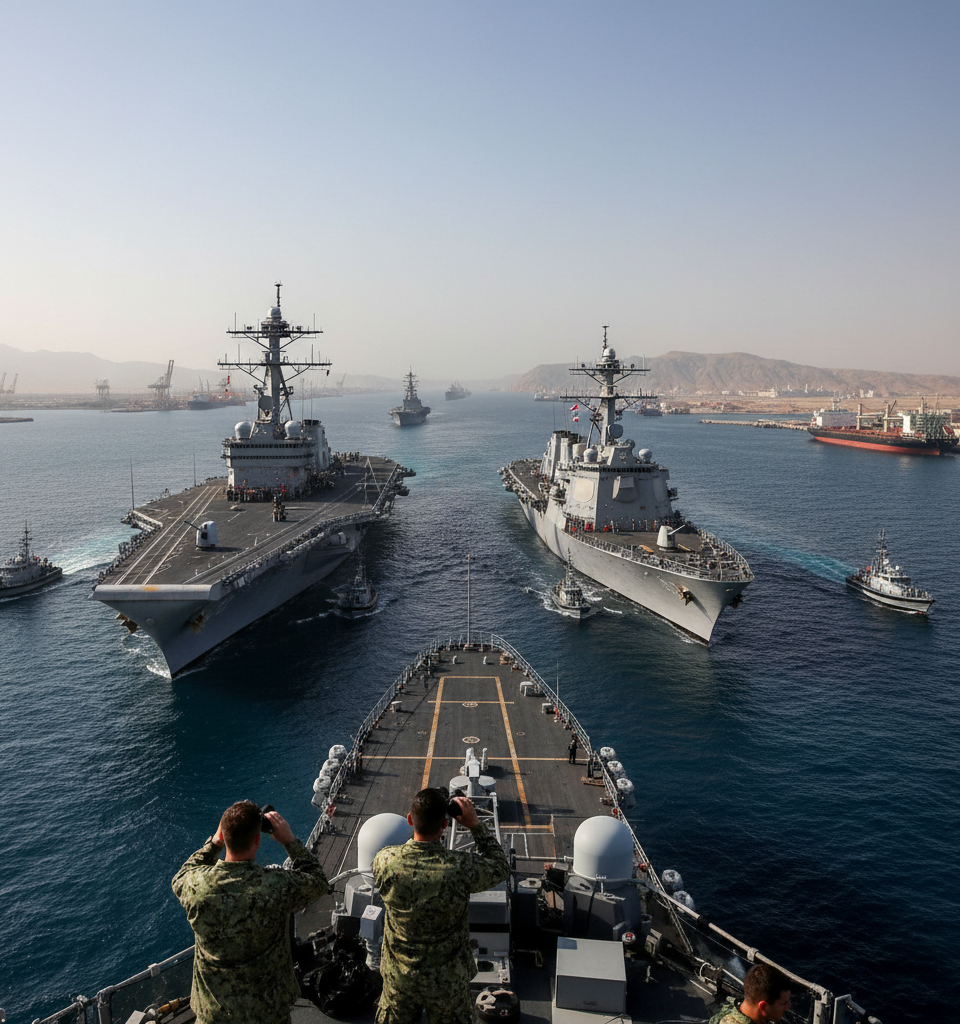
Amid escalating regional tensions, former President Donald Trump's declaration that the United States is blockading Iranian ports in the Strait of Hormuz signifies a potentially dramatic escalation of foreign policy. This pronouncement, delivered with characteristic directness, immediately prompts an in-depth examination of what such an action would entail on a practical and legal level, and its far-reaching consequences for international trade, energy supplies, and geopolitical stability.
Geopolitical Flashpoint: The Strait of Hormuz
The Strait of Hormuz, a narrow waterway connecting the Persian Gulf with the Arabian Sea and the open ocean, is one of the world's most critical maritime chokepoints. Roughly 20% of the world's petroleum liquids consumption, and almost a third of the world's seaborne oil, passes through this strait daily. Its strategic importance makes any disruption, particularly a blockade, an issue of global concern. Iran, with its extensive coastline along the strait, has historically viewed the waterway as vital to its economic and strategic interests, often threatening its closure in response to international pressure. A US-imposed blockade would represent a significant escalation from previous sanctions or naval maneuvers.
The Operational Realities of a Naval Blockade
A naval blockade of Iranian ports in the Strait of Hormuz would be an undertaking of immense complexity and risk. Such an operation would involve the sustained deployment of substantial naval assets, including warships, aircraft carriers, and maritime patrol aircraft, to interdict commercial shipping en route to and from Iranian ports. The goal would be to prevent goods, especially oil and other sanctioned materials, from entering or leaving Iran. This highly militarized posture would inevitably raise the specter of direct confrontation with Iranian naval forces, which regularly operate in the area. The challenges would extend beyond merely patrolling the waters; enforcing such a blockade would require clear rules of engagement, robust intelligence gathering, and the capacity for rapid response to attempts at circumvention.
International Law and Precedent
The legality of a US-imposed blockade without explicit UN Security Council authorization would be highly contentious under international law. While nations can implement blockades in wartime or in response to specific provocations, a unilateral declaration by the United States would likely face widespread international condemnation and challenges to its legitimacy. The 1909 London Declaration concerning the Laws of Naval War, though not universally ratified, provides some framework, but modern international law places significant constraints on such actions, particularly concerning humanitarian access and neutral shipping. The potential for invoking self-defense clauses or other justifications would be intensely scrutinized on the world stage, potentially isolating the US politically.
Economic Devastation and Global Market Repercussions
The economic fallout from a blockade of Iranian ports would be immediate and severe, both for Iran and the global economy. For Iran, it would cripple its primary source of income—oil exports—and significantly impede its ability to import essential goods, potentially leading to widespread shortages and humanitarian concerns. Globally, the mere threat or implementation of such a blockade would send oil prices soaring, creating significant economic instability for energy-dependent nations. Shipping re-routing, increased insurance premiums, and the general uncertainty would disrupt global supply chains far beyond the immediate region, impacting everything from consumer goods to industrial raw materials.
Regional and International Responses
A US blockade would not occur in a vacuum. Regional powers, including Saudi Arabia, the United Arab Emirates, and other Gulf states, would face immense pressure and potential direct impact on their own shipping and security. The responses from major global powers like China, Russia, and the European Union would be crucial. These nations, many of whom have commercial ties with Iran and rely on the stability of global energy markets, could either implicitly or explicitly challenge the blockade, providing Iran with avenues to circumvent it or imposing diplomatic and economic pressure on the United States to de-escalate. The risk of miscalculation leading to broader regional conflict would be exceedingly high.
The Path Forward: Diplomacy or Confrontation?
The assertion of a blockade forces a critical juncture in US-Iran relations and broader Middle East stability. While a naval blockade represents a significant military and economic pressure tactic, its efficacy in achieving long-term policy goals without resort to armed conflict is debatable. Historically, blockades have often been precursors to, or components of, wider military engagements. The international community would undoubtedly call for diplomatic solutions, while the US administration would need to articulate clear objectives and an exit strategy for such a high-stakes maneuver. The ultimate outcome hinges on the willingness of all parties to engage in de-escalation, or conversely, brace for potential confrontation.