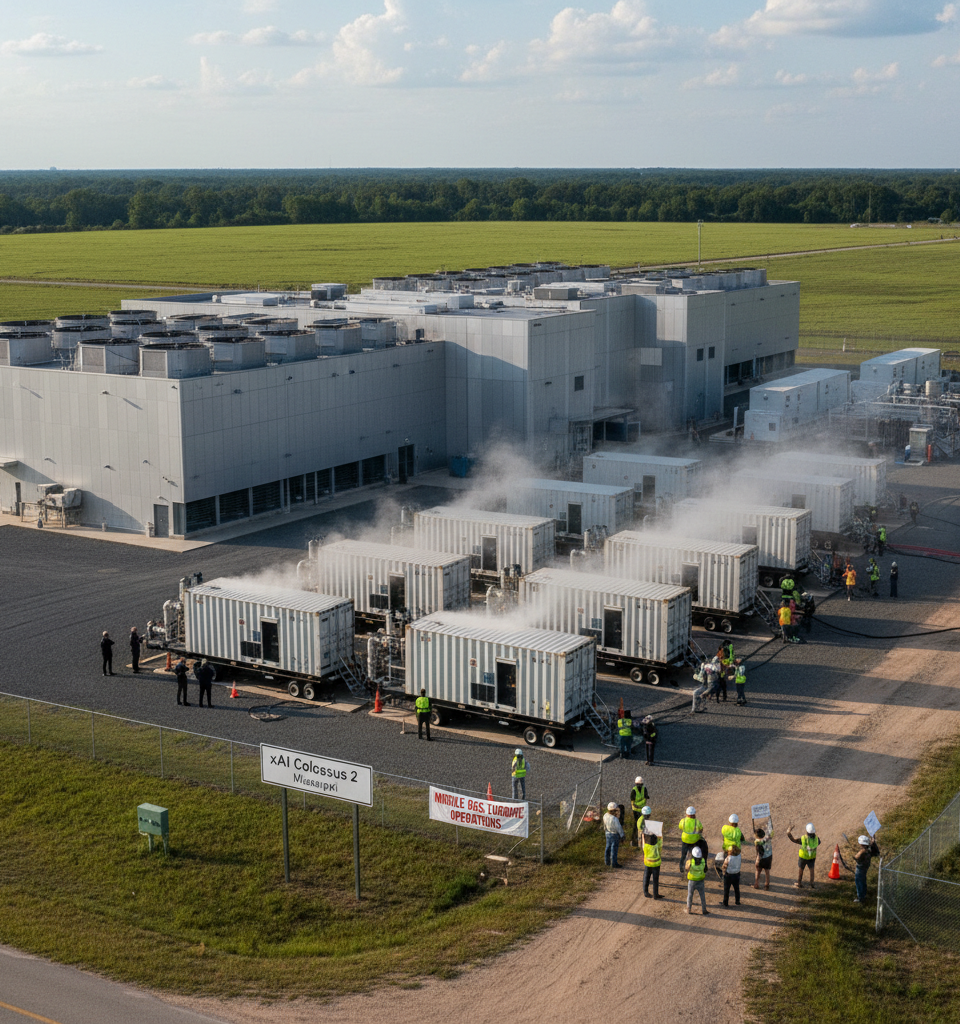
xAI, the artificial intelligence company founded by Elon Musk, has drawn legal scrutiny and public concern over the extensive use of gas turbines to power its Colossus 2 data center in Mississippi. Operating nearly 50 such units, the company is being sued by local environmental groups and residents who contend that xAI is exploiting a regulatory loophole by designating these industrial-scale power generators as 'mobile' units, thereby avoiding more stringent air quality permitting requirements typically associated with permanent power plants. The dispute centers on the environmental impact of these operations, particularly the release of nitrogen oxides and other pollutants into the atmosphere, and the precedent it could set for industrial development in the region.
Context and Background
The rapid expansion of AI necessitates immense computational power, leading to a surge in demand for electricity. Data centers, the backbone of AI operations, are facing unprecedented energy requirements, often exceeding the capabilities of existing grid infrastructure. This challenge has pushed companies to explore alternative, often localized, power generation solutions. xAI's Colossus 2, a significant AI training facility, exemplifies this trend. The use of gas turbines, while offering a potent and flexible power source, particularly when grid connections are insufficient or unreliable, inherently brings environmental considerations to the forefront. The legal challenge highlights a growing tension between technological advancement, energy demand, and environmental protection, particularly as AI infrastructure proliferates across the United States.
Key Details and Allegations
The lawsuit, filed by environmental advocacy groups and local residents, specifically targets xAI's alleged mischaracterization of the turbines. According to court documents, the plaintiffs argue that while individual gas turbines might be technically mobile, their deployment in a fixed array of nearly 50 units at a single industrial site constitutes a permanent power generation facility. This distinction is crucial because permanent facilities are subject to more rigorous environmental impact assessments, emissions limits, and public review processes under the Clean Air Act.
Residents near the data center have reported increased noise pollution and concerns about air quality, attributing these issues to the continuous operation of the numerous turbines. Representatives for xAI have yet to comment publicly on the specifics of the lawsuit, but industry observers suggest the company is likely to argue that it is operating within the legal framework provided for such equipment.
Industry and Market Impact
This legal challenge could have far-reaching implications for the data center industry, particularly for hyperscale AI operations that often require several hundred megawatts of power. As AI deployment scales, reliance on on-site power generation, including gas turbines, is expected to grow. A ruling forcing xAI to reclassify its turbines could set a precedent, compelling other data center developers to undergo more extensive environmental reviews and invest in more advanced emissions controls. This, in turn, could increase the cost and timeline for deploying new AI infrastructure, potentially slowing down the pace of innovation for companies heavily dependent on large-scale computing. The situation also underscores the broader energy transition challenges, as demand for clean energy solutions for data centers intensifies.
Expert Perspective
Environmental law experts highlight the core issue as a potential 'semantic loophole' being exploited by industrial operators. Dr. Eleanor Vance, an environmental policy specialist at a leading university, notes, "The intent of environmental regulations is to manage cumulative impacts. If an operator deploys 50 'mobile' units that collectively function as a stationary power plant, then the spirit, if not the letter, of the law regarding environmental permitting for stationary sources is being circumvented." She added that regulatory bodies often struggle to keep pace with rapidly evolving industrial practices, creating gray areas that companies may exploit for economic advantage. Analysts also point out that while gas turbines offer quick deployment, their carbon footprint is significantly larger than renewable energy sources, prompting calls for more sustainable power solutions for AI.
What's Next
The ongoing legal proceedings are expected to be complex, involving expert testimony on environmental engineering, air quality modeling, and regulatory interpretation. The outcome could significantly influence how large-scale data centers are permitted and regulated across the country. Beyond the immediate legal battle, this situation is likely to accelerate discussions among policymakers about updating environmental regulations to adequately address the unique energy demands and environmental footprints of the burgeoning AI industry. Furthermore, it may spur greater investment in innovative, greener power solutions for data centers, such as advanced modular nuclear reactors or large-scale renewable energy storage, as companies seek to avoid similar regulatory and reputational challenges in the future.