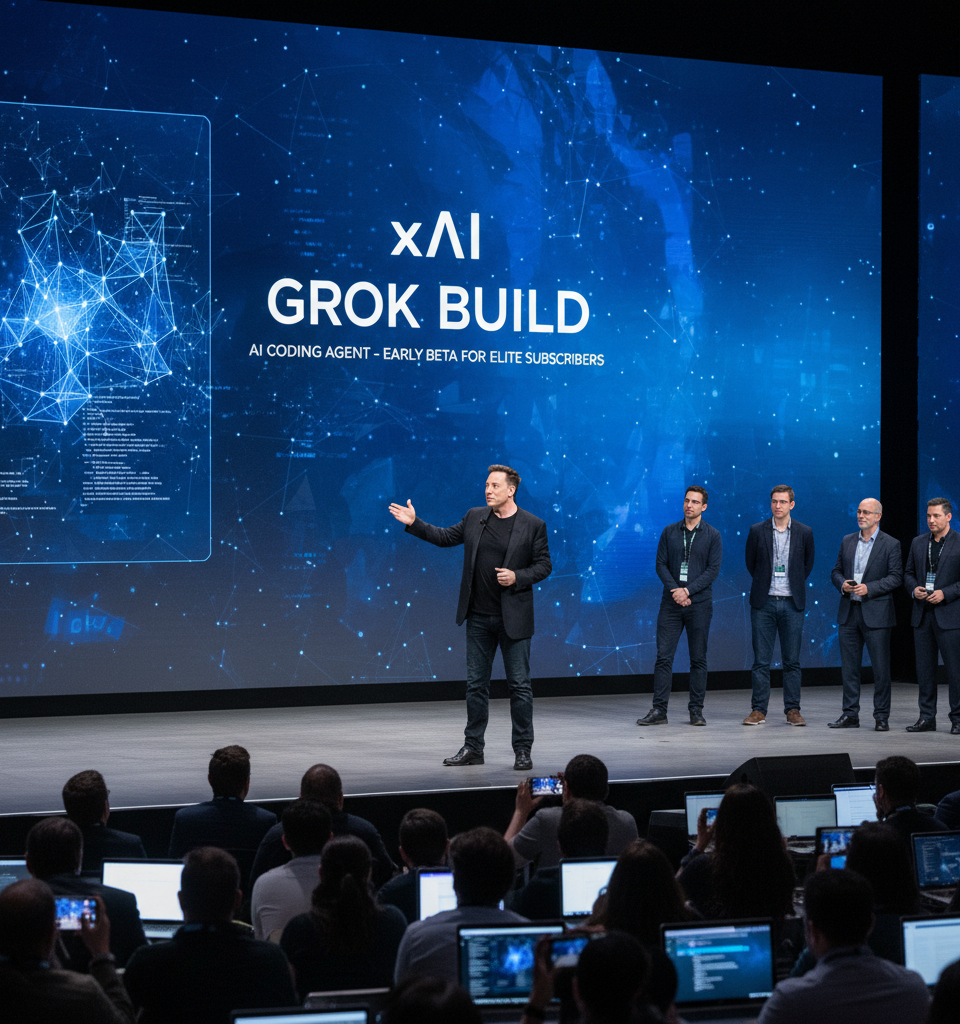
xAI, the artificial intelligence company spearheaded by Elon Musk, has officially launched 'Grok Build,' its eagerly anticipated AI coding agent. The offering, currently in an exclusive early beta phase, marks a significant expansion of xAI's product ecosystem, targeting advanced users within its 'SuperGrok Heavy' subscription tier. This move positions xAI to directly compete in the burgeoning market for AI-assisted software development, leveraging its foundational Grok AI models to streamline and automate coding tasks.
Context and Strategic Significance
The introduction of Grok Build comes at a critical juncture in the AI industry, where automation of complex tasks, particularly in software development, is becoming paramount. Traditional coding processes are often time-consuming and resource-intensive. AI coding assistants promise to accelerate development cycles, improve code quality, and lower barriers to entry for new developers. xAI's foray into this space is not merely about introducing a new tool but about solidifying its position as a holistic AI provider, moving beyond conversational AI to practical application development. This strategic expansion aligns with Musk's broader vision of creating beneficial artificial intelligence that can tackle real-world problems.
Key Features and Access
While specific technical details of Grok Build remain under wraps due to its beta status, it is understood to be designed for generating, debugging, and optimizing code across various programming languages. Access to Grok Build is strictly limited to users subscribed to the 'SuperGrok Heavy' tier. This exclusive access model allows xAI to gather focused feedback from its most engaged and technically proficient users, facilitating rapid iteration and refinement before a wider rollout.
The 'SuperGrok Heavy' subscription tier typically indicates a premium offering, likely encompassing higher usage limits, advanced features, and priority support, reflecting the sophisticated nature of Grok Build's intended functionality. Early indications suggest the agent will integrate seamlessly with existing development workflows, offering suggestions, completing code snippets, and potentially even generating entire functions based on natural language prompts.
Industry and Market Impact
The entry of xAI into the AI coding agent market is expected to intensify competition with established players such as GitHub Copilot (powered by OpenAI's Codex), Amazon CodeWhisperer, and Google's Codey models. These existing solutions have already demonstrated significant productivity gains for developers, with some reports suggesting up to a 55% increase in coding efficiency. xAI's offering, backed by the Grok architecture and Musk's ambitious vision, could disrupt market dynamics by pushing the boundaries of AI's capabilities in code generation and review. The move could also catalyze further innovation across the sector, prompting rivals to accelerate their own development cycles and feature enhancements. The focus on a premium subscriber base initially suggests a strategic play for high-value enterprise development teams or highly productive individual developers.
Expert Perspectives
Industry analysts are closely watching xAI's progress. Dr. Anya Sharma, a lead AI researcher at Tech Insights Group, commented, "Grok Build's launch, even in beta, signifies xAI's serious intent to become a full-spectrum AI player. While the market for AI coding assistants is crowded, xAI's unique architectural approach and access to proprietary data could give Grok Build a distinct advantage, particularly in specialized or complex coding tasks. The limitation to 'SuperGrok Heavy' users is a smart move for controlled testing and building a robust, enterprise-grade tool." Others highlight the importance of model safety and ethical AI development, particularly for code generation, where vulnerabilities or biases could have significant downstream effects.
The Road Ahead
The beta phase of Grok Build will be crucial for gathering user feedback and refining its capabilities. xAI has a track record of rapid iteration and ambitious timelines, suggesting that the public release could follow swiftly, potentially within the next six to twelve months, assuming successful beta testing. Future enhancements are likely to include expanded language support, deeper integration with popular IDEs and version control systems, and potentially capabilities for automated testing and deployment.
The success of Grok Build will not only depend on its technical prowess but also on its ability to integrate seamlessly into existing developer workflows and offer a clear value proposition over competitive tools. This launch positions xAI as a formidable challenger in the competitive landscape of AI-powered developer tools, with broader implications for the future of software development.